Ohtani intro
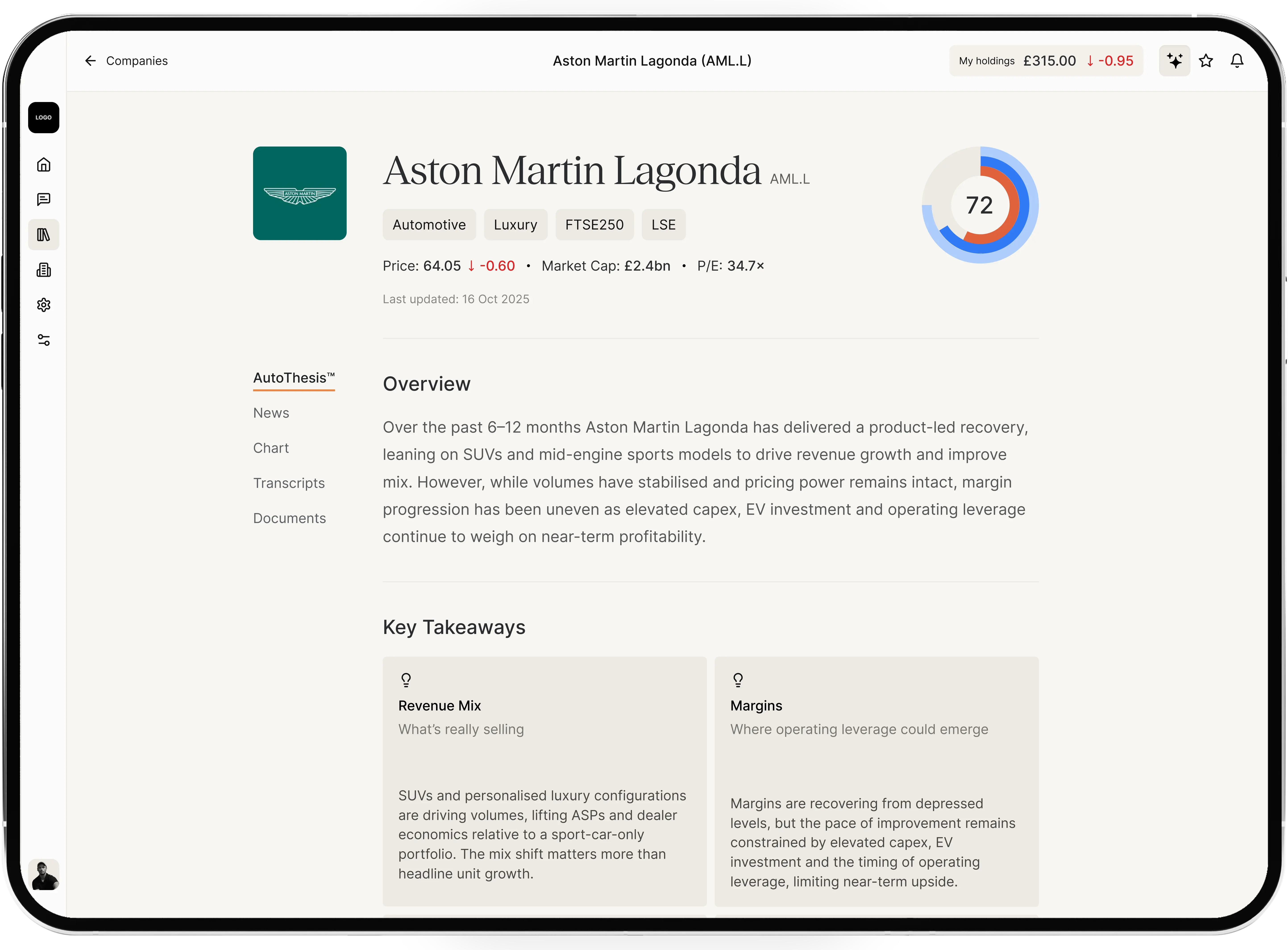
Ohtani is an AI-powered platform designed to unify narrative insight and financial data into a single, continuously evolving investment view. While markets have become increasingly data-driven, the process of forming conviction remains fragmented—spread across documents, models, and conversations.
Ohtani intro
Ohtani is an AI-powered platform designed to unify narrative insight and financial data into a single, continuously evolving investment view. While markets have become increasingly data-driven, the process of forming conviction remains fragmented—spread across documents, models, and conversations.
Ohtani is an AI-powered platform designed to unify narrative insight and financial data into a single, continuously evolving investment view. While markets have become increasingly data-driven, the process of forming conviction remains fragmented—spread across documents, models, and conversations.
Ohtani video
Ohtani video
The Challenge
Investment decisions require analysts to combine quantitative data with qualitative judgement — reading transcripts, interpreting strategy shifts, tracking how a narrative evolves over time. Today that process is entirely manual and deeply fragmented: research reports in one place, financial models in another, institutional knowledge locked inside people's heads. The product challenge was to design a system that could unify narrative and numbers into a single, continuously updated investment view — without removing the human judgement that makes the difference between data and conviction.
The Challenge
Investment decisions require analysts to combine quantitative data with qualitative judgement — reading transcripts, interpreting strategy shifts, tracking how a narrative evolves over time. Today that process is entirely manual and deeply fragmented: research reports in one place, financial models in another, institutional knowledge locked inside people's heads. The product challenge was to design a system that could unify narrative and numbers into a single, continuously updated investment view — without removing the human judgement that makes the difference between data and conviction.
Investment decisions require analysts to combine quantitative data with qualitative judgement — reading transcripts, interpreting strategy shifts, tracking how a narrative evolves over time. Today that process is entirely manual and deeply fragmented: research reports in one place, financial models in another, institutional knowledge locked inside people's heads. The product challenge was to design a system that could unify narrative and numbers into a single, continuously updated investment view — without removing the human judgement that makes the difference between data and conviction.
.webp)
My Role
As the lead designer at Ohtani, I owned the end-to-end product experience — brand identity, architecture, design system, interaction, and visual design. The process was built around continuous collaboration with a professional investment firm, with fund managers and analysts involved from discovery through to validation. I also worked directly with the engineering and AI teams to understand how the models behave in practice, using that to shape how outputs were structured and made trustworthy for professional use.
My Role
As the lead designer at Ohtani, I owned the end-to-end product experience — brand identity, architecture, design system, interaction, and visual design. The process was built around continuous collaboration with a professional investment firm, with fund managers and analysts involved from discovery through to validation. I also worked directly with the engineering and AI teams to understand how the models behave in practice, using that to shape how outputs were structured and made trustworthy for professional use.
As the lead designer at Ohtani, I owned the end-to-end product experience — brand identity, architecture, design system, interaction, and visual design. The process was built around continuous collaboration with a professional investment firm, with fund managers and analysts involved from discovery through to validation. I also worked directly with the engineering and AI teams to understand how the models behave in practice, using that to shape how outputs were structured and made trustworthy for professional use.

Branding
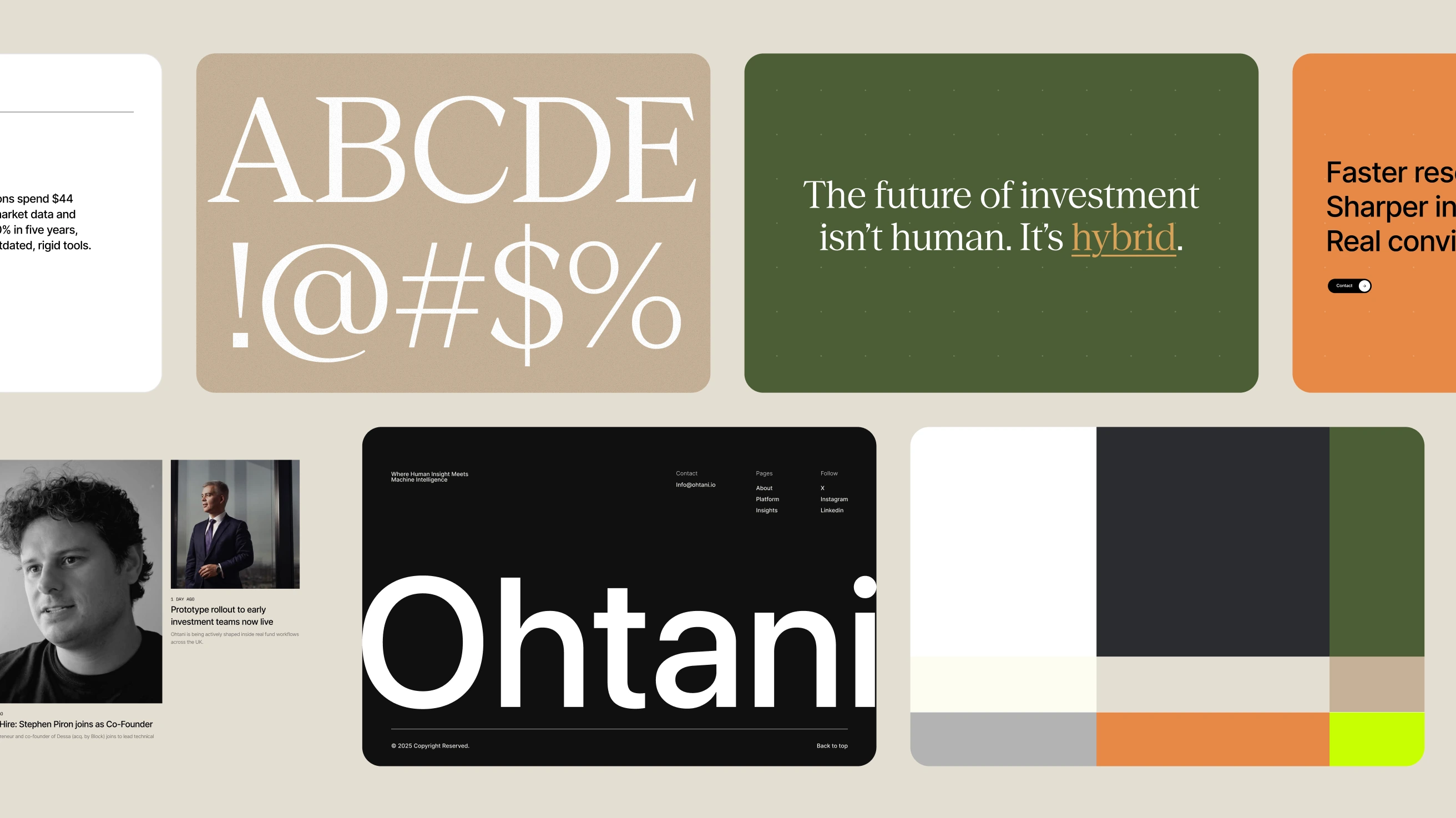
Alongside the product, I defined the visual identity for Ohtani — logo, colour system, and typography. The goal was a brand that felt institutional and precise without being cold: something that could sit comfortably alongside the tools professional investors already use, while signalling that this was something genuinely new.
Branding
Alongside the product, I defined the visual identity for Ohtani — logo, colour system, and typography. The goal was a brand that felt institutional and precise without being cold: something that could sit comfortably alongside the tools professional investors already use, while signalling that this was something genuinely new.
Alongside the product, I defined the visual identity for Ohtani — logo, colour system, and typography. The goal was a brand that felt institutional and precise without being cold: something that could sit comfortably alongside the tools professional investors already use, while signalling that this was something genuinely new.
Ohtani full image
Ohtani full image
The Solution
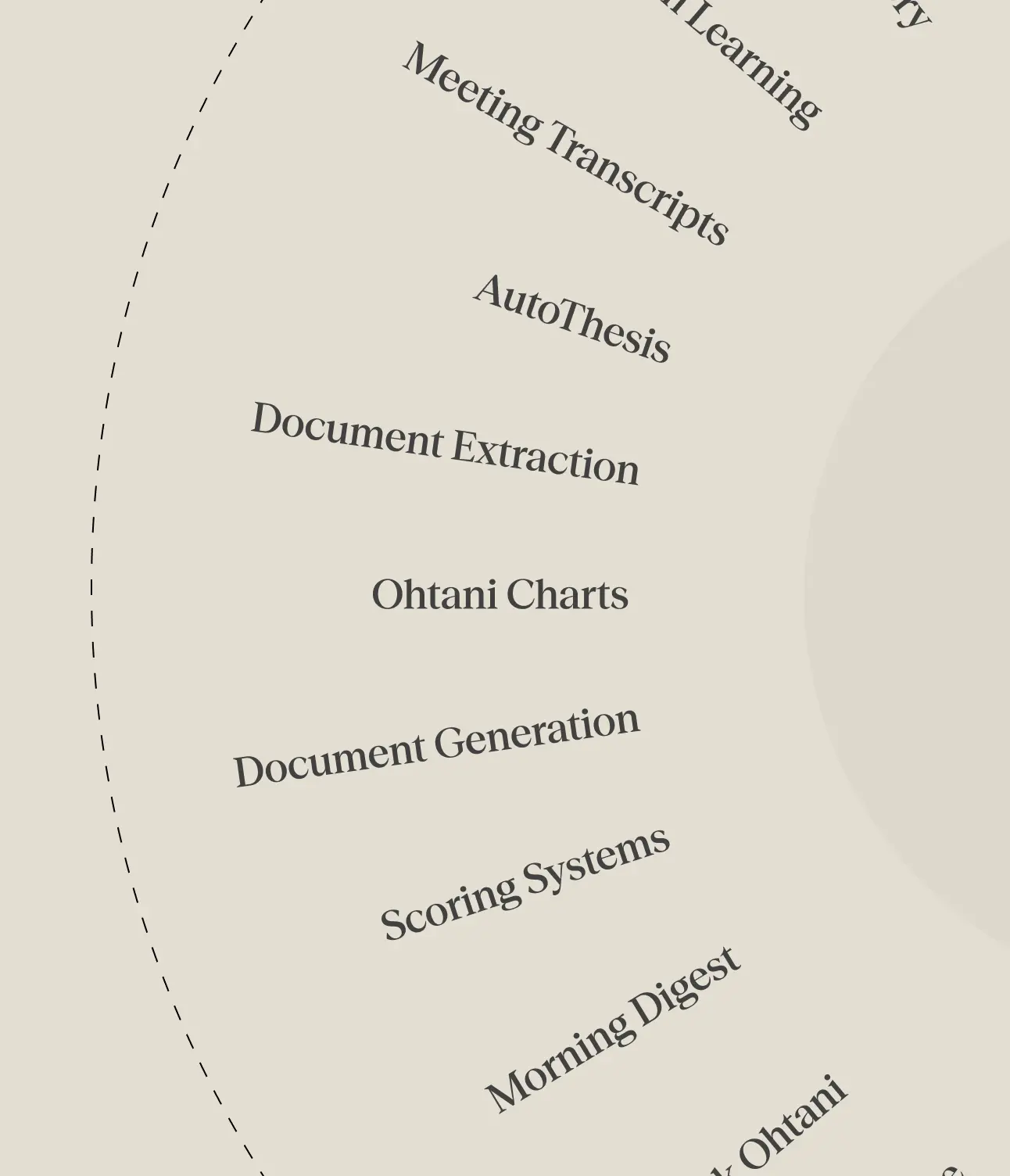
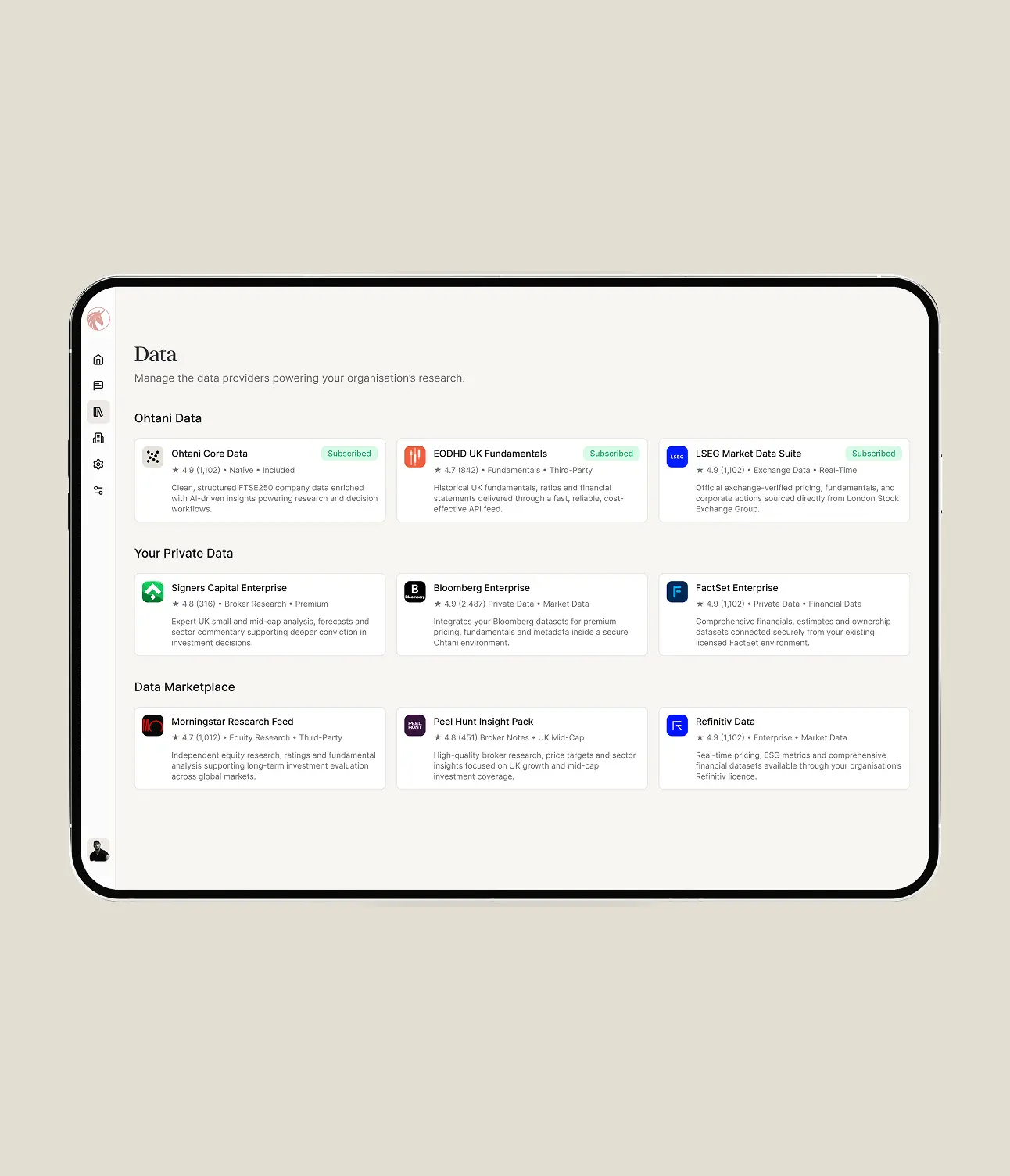
Ohtani acts as a decision-support layer that continuously ingests information, synthesises insight, and surfaces what matters. At the core is the Cognitive Twin — an always-on AI layer unique to each user, built across three levels: organisation memory, fund memory, and individual memory. It surfaces as an ambient presence across the morning digest, signals, and thesis updates. Infrastructure, not a character.
The Solution
Ohtani acts as a decision-support layer that continuously ingests information, synthesises insight, and surfaces what matters. At the core is the Cognitive Twin — an always-on AI layer unique to each user, built across three levels: organisation memory, fund memory, and individual memory. It surfaces as an ambient presence across the morning digest, signals, and thesis updates. Infrastructure, not a character.
Ohtani acts as a decision-support layer that continuously ingests information, synthesises insight, and surfaces what matters. At the core is the Cognitive Twin — an always-on AI layer unique to each user, built across three levels: organisation memory, fund memory, and individual memory. It surfaces as an ambient presence across the morning digest, signals, and thesis updates. Infrastructure, not a character.
Insight Extraction
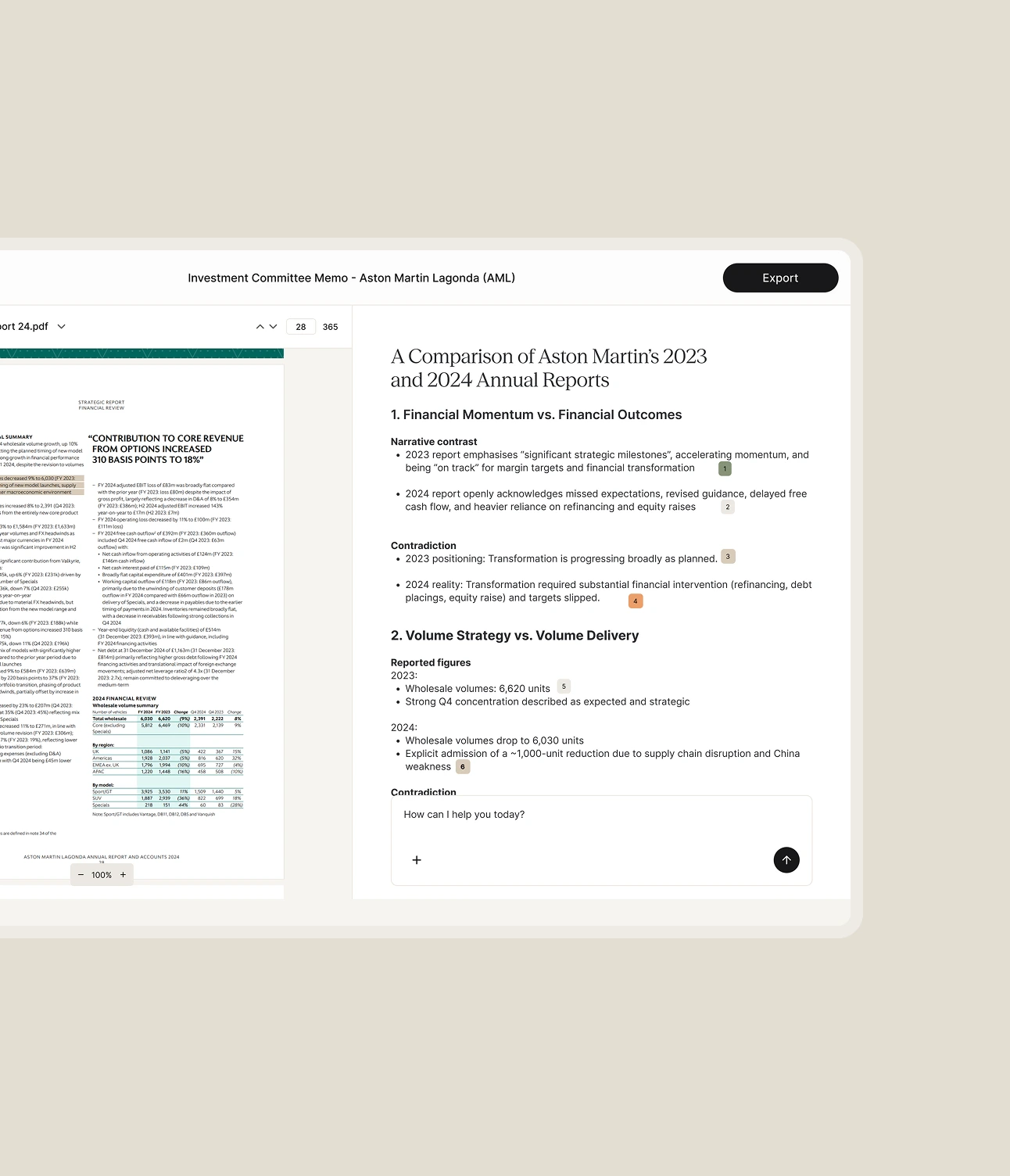
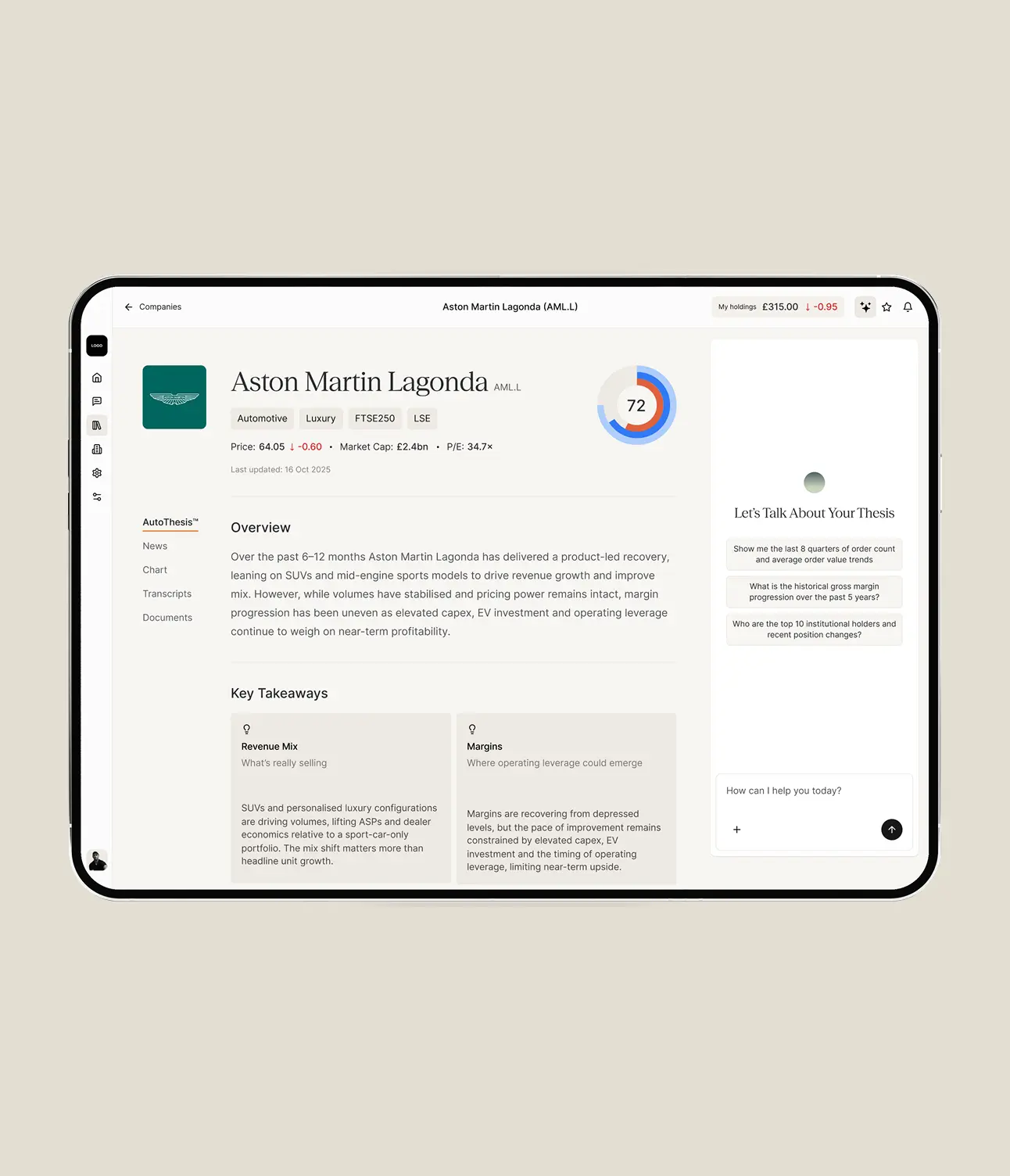
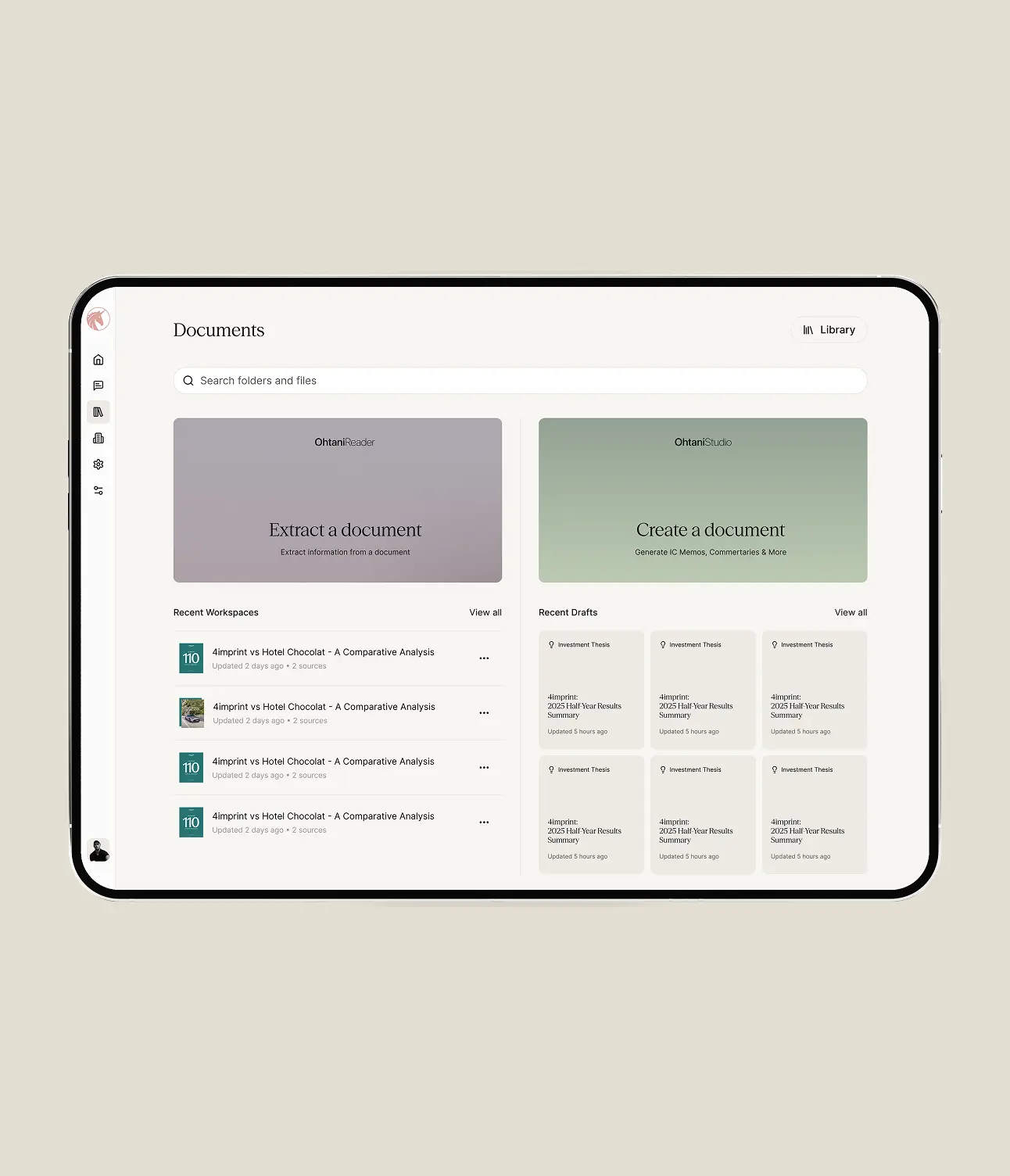
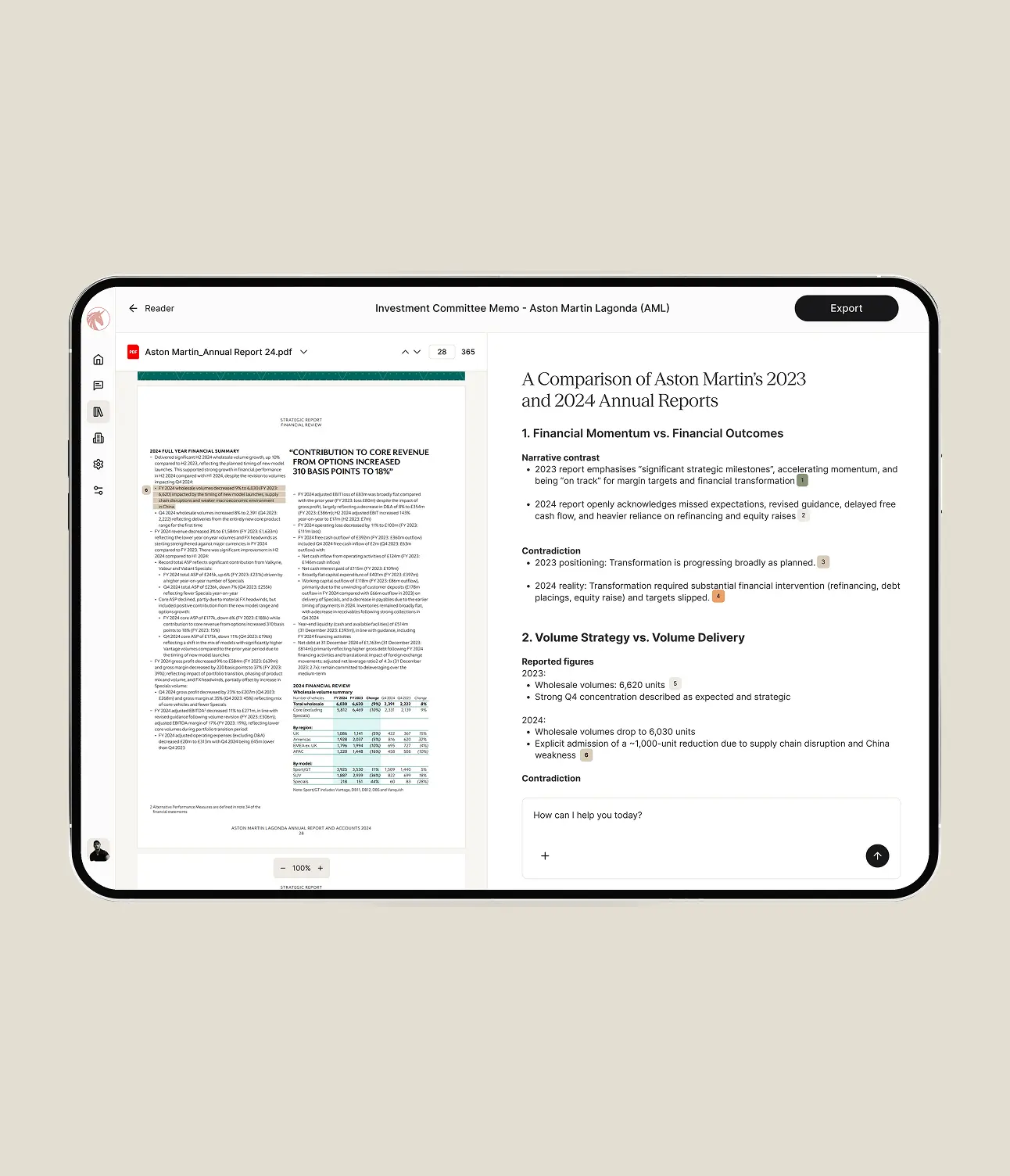
Documents are synthesised to surface key risks, assumptions, and narrative shifts. I built a layered output pattern — structured summary at the top, source passages beneath — so the AI handles compression while the analyst retains full control. Every claim is traceable back to its origin. The platform also actively flags bias: where an analyst's own notes show confirmation bias or downside risks are being underweighted, the system surfaces that rather than simply reinforcing the existing view.
Insight Extraction
Documents are synthesised to surface key risks, assumptions, and narrative shifts. I built a layered output pattern — structured summary at the top, source passages beneath — so the AI handles compression while the analyst retains full control. Every claim is traceable back to its origin. The platform also actively flags bias: where an analyst's own notes show confirmation bias or downside risks are being underweighted, the system surfaces that rather than simply reinforcing the existing view.
Documents are synthesised to surface key risks, assumptions, and narrative shifts. I built a layered output pattern — structured summary at the top, source passages beneath — so the AI handles compression while the analyst retains full control. Every claim is traceable back to its origin. The platform also actively flags bias: where an analyst's own notes show confirmation bias or downside risks are being underweighted, the system surfaces that rather than simply reinforcing the existing view.
Interaction
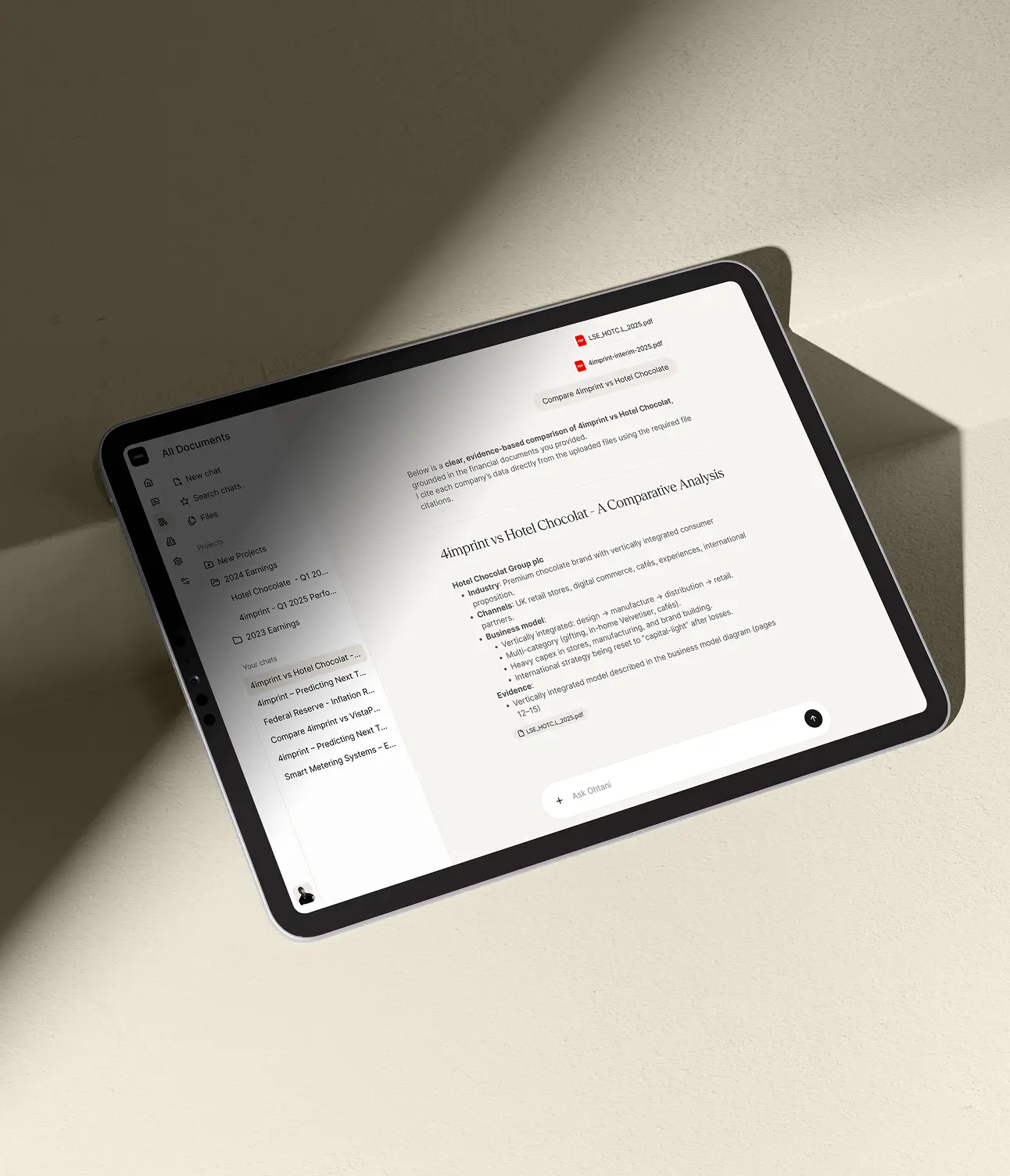
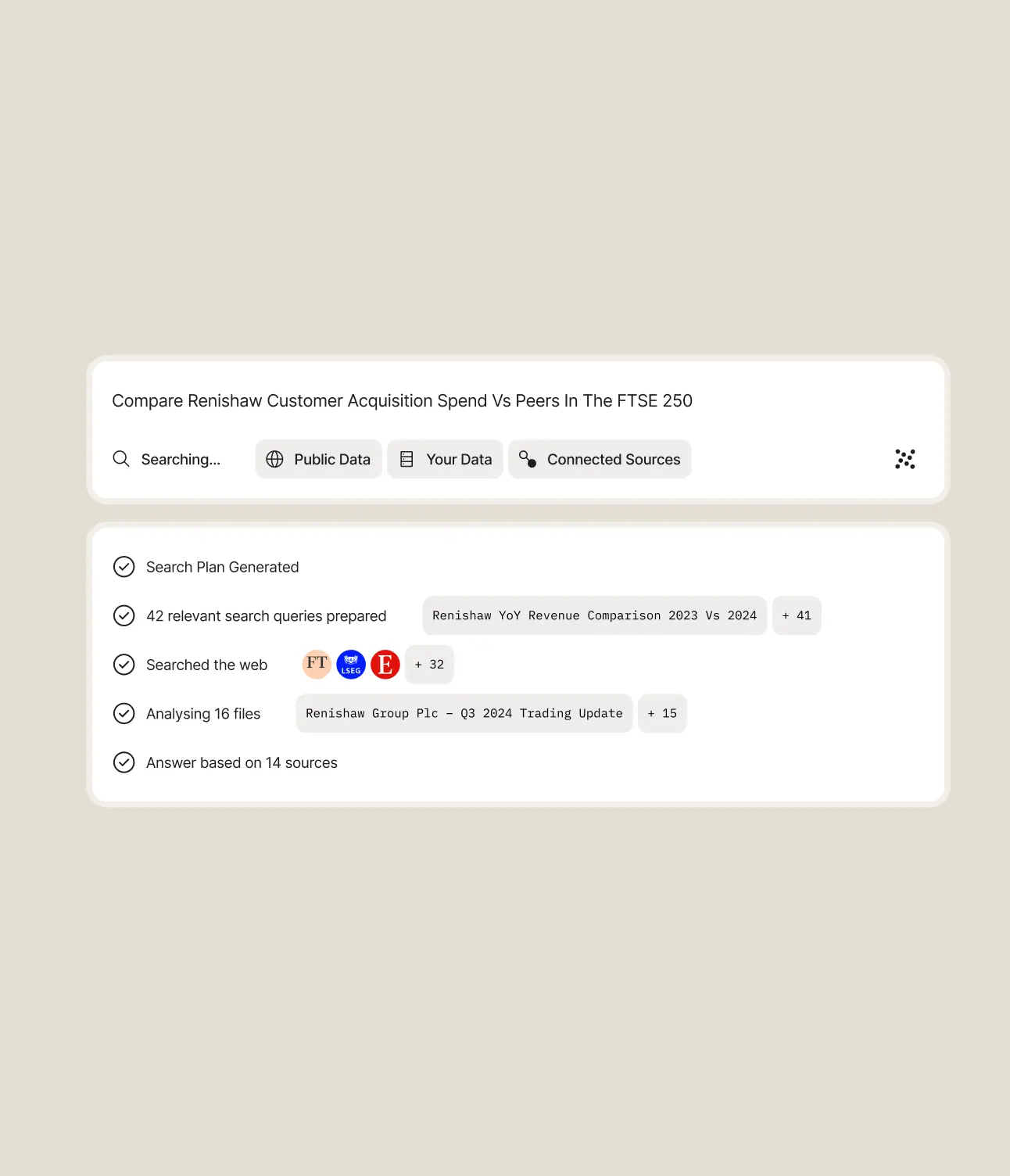
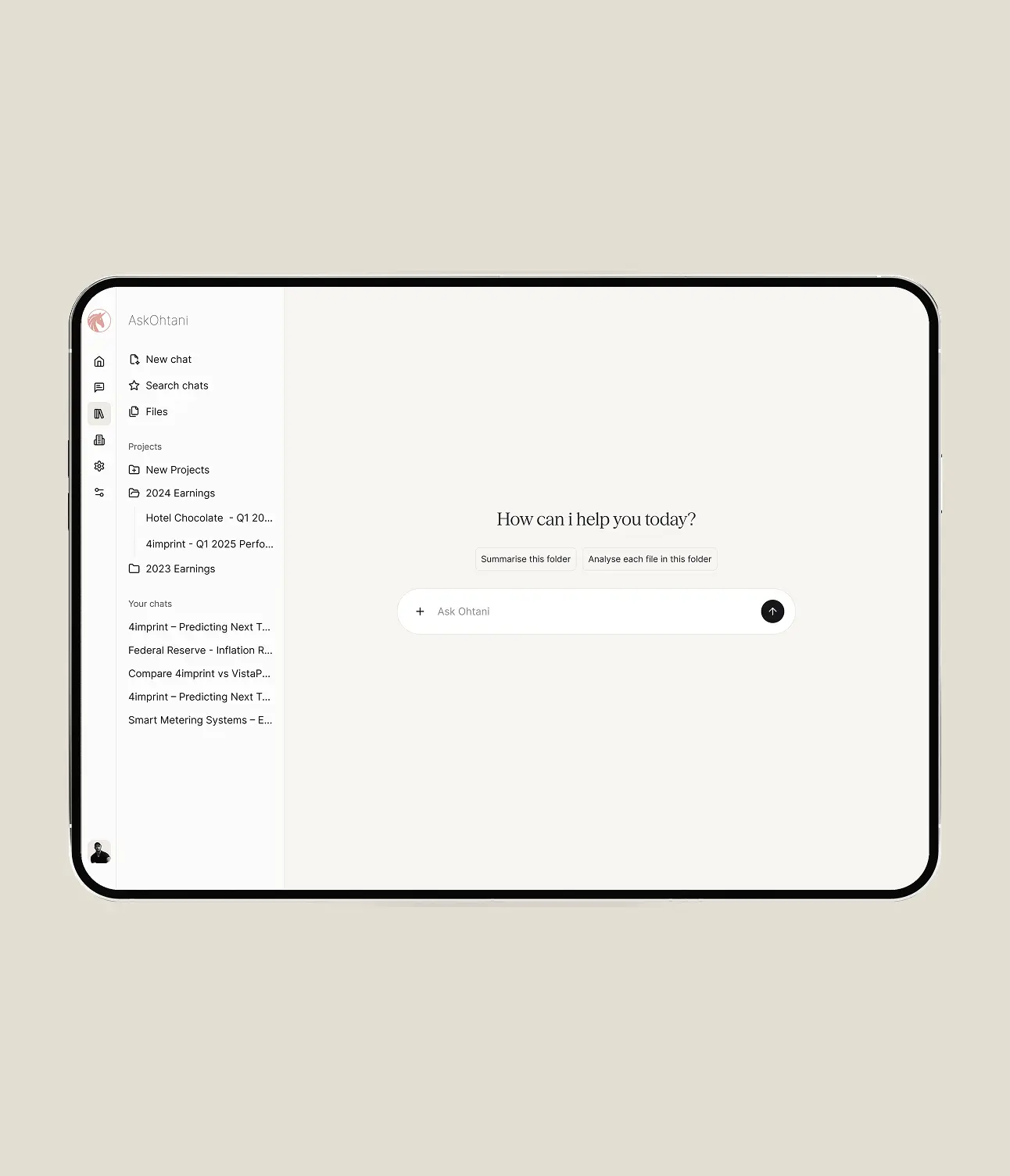
Investors interact with their data conversationally rather than through complex query languages. The design challenge was tone — the interface needed to feel precise and capable, not like a consumer chatbot. I focused on response patterns that surface structured outputs directly from natural language queries, maintaining the fidelity professionals expect while dramatically lowering the barrier to complex workflows.
Interaction
Investors interact with their data conversationally rather than through complex query languages. The design challenge was tone — the interface needed to feel precise and capable, not like a consumer chatbot. I focused on response patterns that surface structured outputs directly from natural language queries, maintaining the fidelity professionals expect while dramatically lowering the barrier to complex workflows.
Investors interact with their data conversationally rather than through complex query languages. The design challenge was tone — the interface needed to feel precise and capable, not like a consumer chatbot. I focused on response patterns that surface structured outputs directly from natural language queries, maintaining the fidelity professionals expect while dramatically lowering the barrier to complex workflows.
Signals
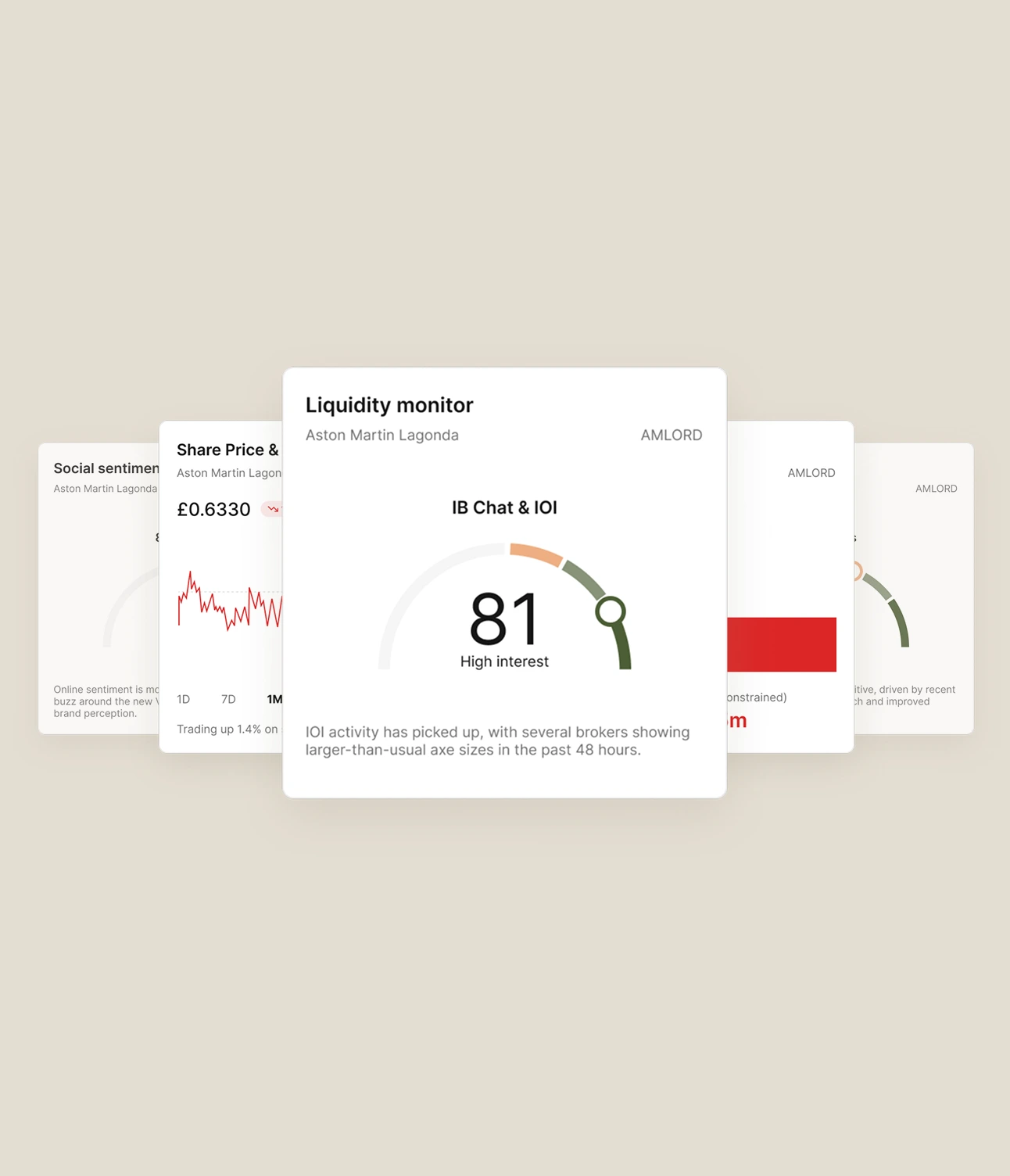
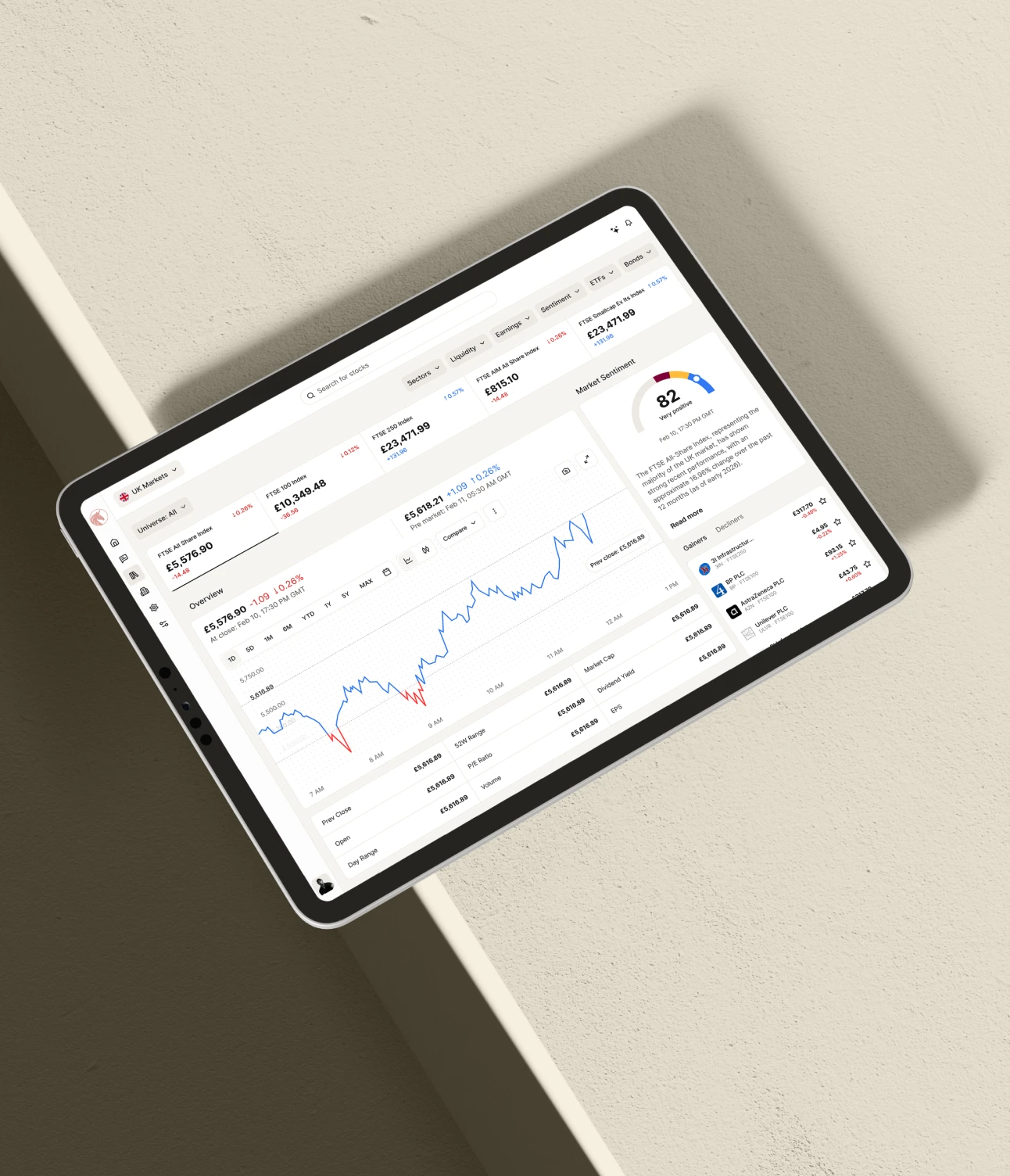
I designed the signals layer around relevance-to-mandate — alerts aren't just "something changed" but "something changed that matters to your specific position." Every signal carries enough context to be actionable without adding to the cognitive load the platform was built to reduce.
Signals
I designed the signals layer around relevance-to-mandate — alerts aren't just "something changed" but "something changed that matters to your specific position." Every signal carries enough context to be actionable without adding to the cognitive load the platform was built to reduce.
I designed the signals layer around relevance-to-mandate — alerts aren't just "something changed" but "something changed that matters to your specific position." Every signal carries enough context to be actionable without adding to the cognitive load the platform was built to reduce.
Ohtani images 1
Ohtani images 1
Ohtani images 2
Ohtani images 2
Ohtani images 3
Ohtani images 3
The Outcome
Ohtani launched as a functional platform and was demonstrated to institutional investors and pilot users across the UK buy side. The product was validated in real workflows with active fund managers — shaping features, challenging assumptions, and confirming that the design was doing its job of making complex AI output feel navigable, trustworthy, and genuinely useful under pressure.
The Outcome
Ohtani launched as a functional platform and was demonstrated to institutional investors and pilot users across the UK buy side. The product was validated in real workflows with active fund managers — shaping features, challenging assumptions, and confirming that the design was doing its job of making complex AI output feel navigable, trustworthy, and genuinely useful under pressure.
Ohtani launched as a functional platform and was demonstrated to institutional investors and pilot users across the UK buy side. The product was validated in real workflows with active fund managers — shaping features, challenging assumptions, and confirming that the design was doing its job of making complex AI output feel navigable, trustworthy, and genuinely useful under pressure.